Noēma, from the ancient Greek for “thinking” or “object of thought,” is a longform journalism magazine exploring the transformations shaping our world, featuring essays, interviews, reportage, videos, and art across technology, philosophy, governance, economics, geopolitics, and culture.

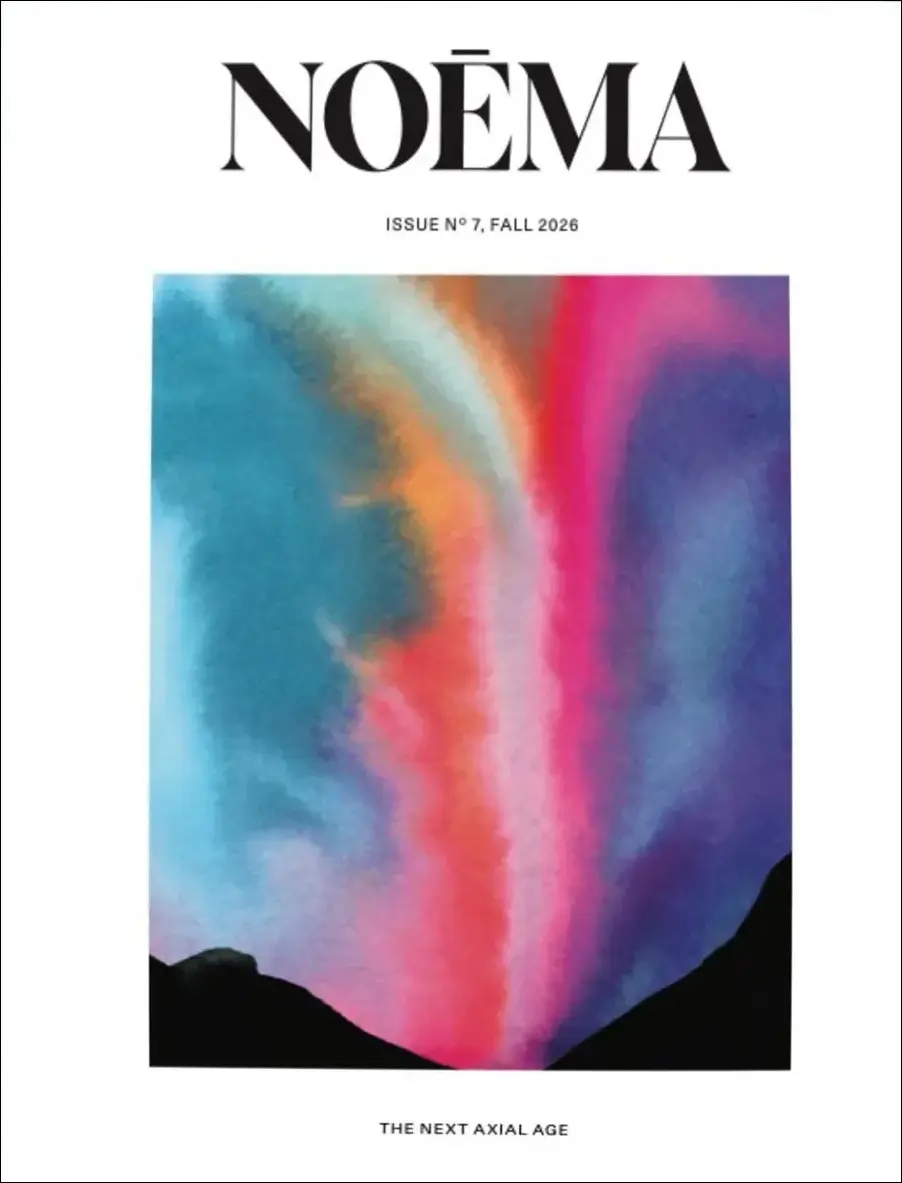
Noēma #7
€22.95
In stock
Description
THE NEXT AXIAL AGE
It’s time for a synchronous global rethink.
This issue’s theme explores the possibility that we are entering a new “Axial Age.”
Recent leaps in science and technology, notably genetic engineering, synthetic biology and artificial intelligence, are resurrecting the religious and ethical imagination as they stir anew foundational questions about our origins and destiny. Even the survival of the species is at risk due to the planetary climate crisis.
With no shared ideational framework and dwindling trust in bequeathed faiths and institutions, humanity is being forced back to first principles. The time for a synchronous global rethink appears to have arrived.
The philosopher Karl Jaspers was best known for his study of the so-called “Axial Age,” when all the great religions and philosophies were born in relative simultaneity more than two millennia ago — Confucianism in China, the Upanishads and Buddhism in India, Homer in Greece and the Hebrew prophets in the Middle East. These civilizations arose in the long wake of inventions such as the forging of iron tools, which fostered the rise of agriculture and urban settlements as well as enabled more violent and destructive warfare. Unmoored from the familiarity of close community and their natural environment, people lost their existential anchor.
For the philosopher Charles Taylor, the Axial Age awakenings resulted from the “great dis-embedding” of the person from those isolated confines, where circumscribed awareness had been limited to the sustenance and survival of the tribe guided by oral narrative myth. This lifting out from a closed-off world, according to Taylor, was enabled by the arrival of written language — the stored memories of the first cloud technology. This attainment of symbolic competency capacitated an “interiority of reflection” based on abiding texts that created a platform for shared meanings beyond one’s immediate circumstances and local narratives.
Long story very short, this “transcendence” led to the possibility of general philosophies, monotheistic religions and broad-based ethical systems. The critical self-distancing quality of dis-embedded reflection further evolved into what the sociologist Robert Bellah called “theoretic culture,” which ultimately led to scientific discovery and the Enlightenment. For Bellah, “Plato completed the transition to the Axial Age” with the concept of theoria, which “enables the mind to ‘view’ the great and the small in themselves abstracted from their concrete manifestations.”
Because the general conditions of societies from 800 to 200 B.C.E. were contemporaneous across so many lands, the transition to the Axial Age among them was also roughly contemporaneous.
This pre-Axial period was so widely characterized by the upheavals of war and violence — the Warring States era in China, the clash of emergent kingdoms in India, the recurrent battles of classical Greece — that the existential imperative to make sense of it all and seek release from the cycle of suffering reached a critical threshold. It was in this context that the technology of written language enabled philosophical exchange, codification of ethical systems and shared metaphysical notions of salvation from the earthly storm. The sense of “ontological security,” promised amid perpetual turmoil, spread the appeal among constituencies far and wide.
Jaspers characterized the Axial Age as “the moment when man becomes conscious of Being as a whole, of himself and his limitations” and “experiences absoluteness in the depths of selfhood and in the lucidity of transcendence.” For Bellah: “The theoretical breakthrough in each axial case led to the possibility of universal ethics, the reassertion of fundamental human equality and the necessity of respect for all humans, indeed all sentient beings.”
For the historian Karen Armstrong, the great breakthrough of the Axial Age was the common recognition that the greed, egotism, hatred and violence at the root of suffering could be transcended through “the abandonment of narrow selfishness and the spirituality of compassion” — in effect, the Golden Rule of a broad enough empathetic vision of the relational nature of reality to see that you should do unto others only what you would have them do unto you.
In more complex sociological terms, the philosopher Jürgen Habermas situates the axial awakenings in the lifeworld domains of culture, society and personality. “At the level of cultural tradition,” he has said, “the perspective broadens with the reference to a transcendent vanishing point in such a way that the worldviews that now promote reflections on human beings in existence as a whole are coupled with a new historical consciousness of the contingency of all occurrences in the world.
“At the level of social relations,” Habermas continued, “this expansion of horizons facilitates a universalist point of view that reveals both general norms binding all believers equally, as well as possible historical alternatives to the existing political order. At the personal level, the reference to transcendence gives rise to a view of oneself that is individualizing and, at the same time, reflective. One becomes aware of freedom and personal responsibility, on the one hand, and becomes interested in the success of one’s own life in terms of salvation history, on the other.”
You may also like…

Related products




Updating…